
What Is Hot Wire Foam Cutting and When Should You Use It?
A heated wire can turn a block of polystyrene into a precise, consistent profile in a matter of seconds. For projects requiring repeatable shapes in expanded polystyrene (EPS) or extruded polystyrene (XPS), hot wire foam cutting can provide an efficient way to produce components at scale.
But what exactly is hot wire foam cutting, how does it work, and when is it the right choice for your project?

What is hot wire foam cutting?
Hot wire foam cutting is a CNC-controlled manufacturing process that uses a heated wire to cut precise profiles through polystyrene. The wire travels along a programmed path, melting a clean and accurate cut through the stock material.
The process is particularly suited to EPS and XPS polystyrene and can produce consistent, repeatable shapes with minimal material waste.
At Perudo Realisations, hot wire cutting is one of the processes used as part of our polystyrene converting service helping businesses turn polystyrene blocks and sheets into bespoke components for a range of applications.
Hot wire foam cutting at a glance
| Question | Answer |
| What is hot wire foam cutting? | A CNC-controlled process that uses a heated wire to cut precise profiles through foam. |
| What materials can be hot wire cut? | Primarily expanded polystyrene (EPS) and extruded polystyrene (XPS). |
| How does it cut the material? | The heated wire melts through the polystyrene along a programmed profile. |
| What is it best suited to? | Repeatable profiles and shapes, particularly where multiple consistent components are required. |
| What are the main benefits? | Speed, consistency, repeatability and reduced material waste. |
| Can it create complex 3D shapes? | It can produce a range of profiles, but more complex 3D geometry and detailed features may be better suited to CNC routing and milling. |
| What is hot wire cutting used for? | Applications include structural fill, concrete formwork, packaging, display shapes and certain insulation components. |
| How is it different from CNC routing? | Hot wire cutting melts through polystyrene with a heated wire, while CNC routing physically removes material with a cutting tool and offers greater control over detailed features. |

How does hot wire foam cutting work?
The process begins with the required shape being defined digitally. CNC programming then controls the movement of the heated wire, guiding it through the polystyrene along the specified profile.
As the heated wire passes through the material, it melts its way through rather than mechanically removing the foam. This produces a clean, consistent cut following the programmed shape.
Because the wire follows the same programmed movement for each component, the profile can be reproduced consistently across a production run. This makes hot wire cutting particularly useful when you need multiple components with the same dimensions and shape.
The process can also minimise material waste because the wire follows a defined cutting path through the polystyrene.
What materials can be hot wire cut?
Hot wire cutting is primarily used for two types of polystyrene:
Expanded polystyrene (EPS)
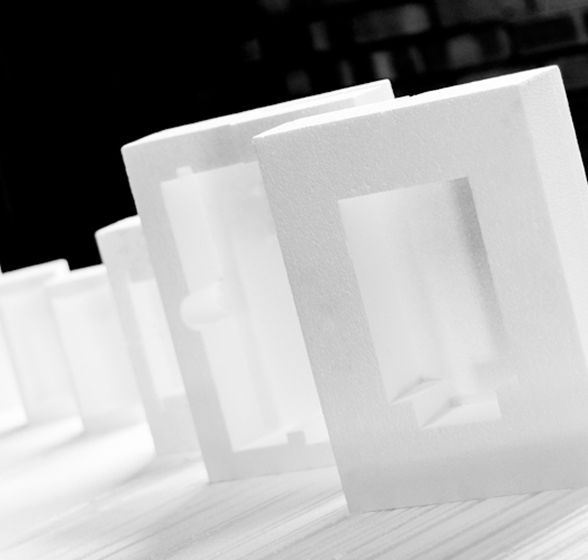
EPS is a lightweight foam material that can be converted into bespoke shapes and components for applications including packaging, construction and display.
Hot wire cutting can be particularly useful when EPS components need to follow the same profile across a production run.
Extruded polystyrene (XPS)
XPS is another form of polystyrene commonly used where its particular material properties make it suitable for the application.
As with EPS, hot wire cutting can produce repeatable profiles where the design suits the process.
It is important to note that hot wire cutting is primarily a polystyrene cutting process. If your project involves materials such as wood, plastics, insulation boards, aluminium composite panel (ACP) or composite sandwich panels, CNC routing may be a more suitable approach.
Find out more about the wider range of materials and applications covered by Perudo’s CNC routing and cutting service.
What are the benefits of hot wire foam cutting?
Speed and efficiency
Hot wire cutting is well suited to producing repeatable profiles efficiently.
Once the required profile has been programmed, the same shape can be produced repeatedly without having to manually cut each component. This can make the process particularly useful for production runs involving multiple similar parts.
Consistent results
Consistency is important when components need to form part of a larger product, construction project or installation.
CNC control allows the same programmed profile to be reproduced across a production run, helping maintain consistency from the first component to the last.
Minimal material waste
The heated wire follows a defined path through the polystyrene rather than removing material with a conventional cutting tool.
For suitable profiles, hot-wire cutting can reduce the amount of material waste generated during the cutting process. Any suitable offcuts can also be recycled and reintroduced into the material production process, helping to support a more circular approach to manufacturing.
Cost-effective for suitable profiles
Hot wire cutting can be a cost-effective option when you need simple, repeatable profiles and do not require the additional machining involved in creating detailed features.
The key is choosing a process that matches the design. A more complex manufacturing method is not necessarily worthwhile when the finished component only needs a simple profile.
What is hot wire cutting used for?
Hot wire foam cutting has applications across construction, packaging, events, exhibitions and other manufacturing environments.
Structural fill and concrete formwork
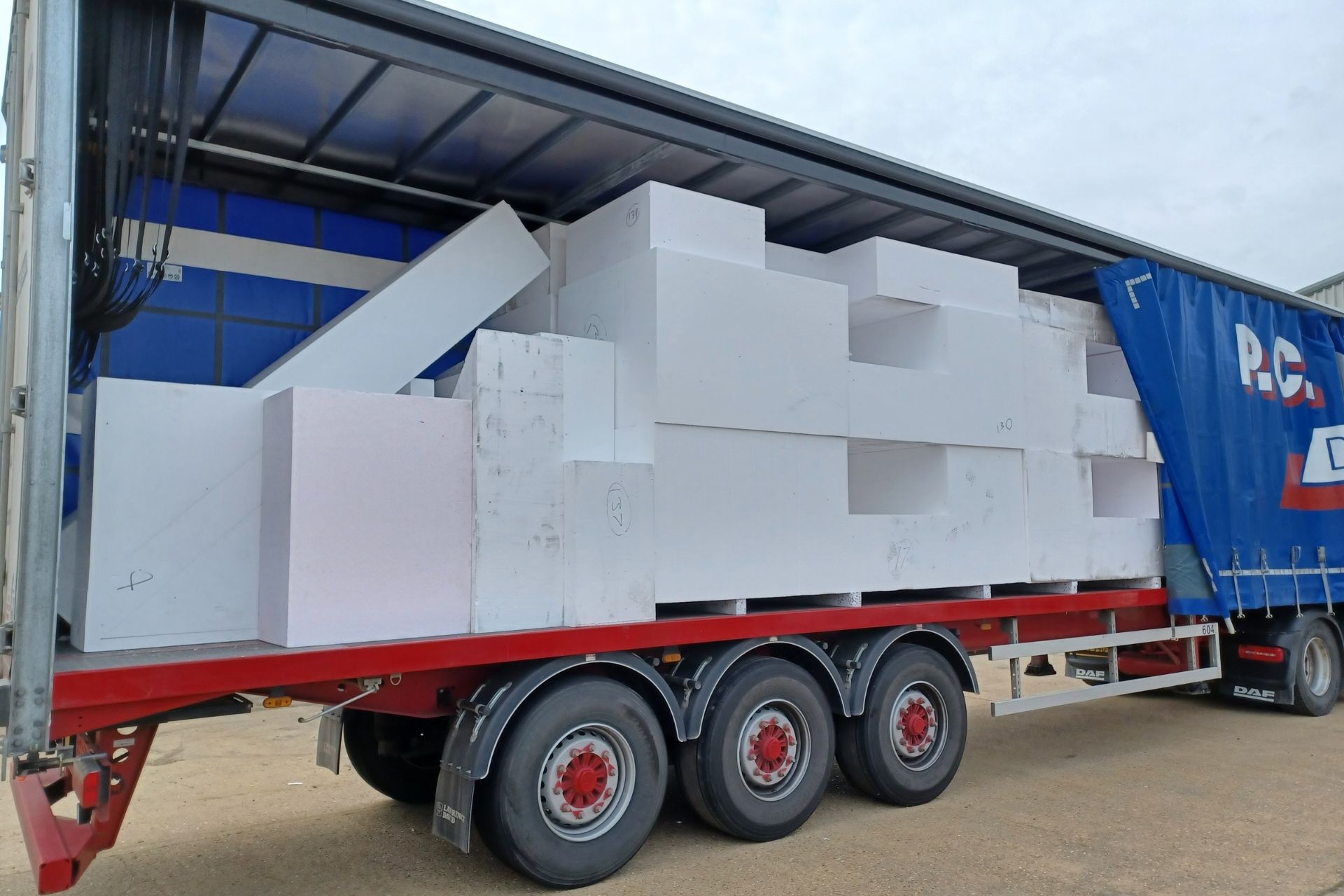
Polystyrene can be shaped into bespoke components for construction and concrete applications, including structural fill, formwork and void fillers. Where the same profile is required across multiple components, hot wire cutting provides an efficient way to produce consistent pieces.
Bespoke packaging
Packaging often needs to be designed around the product it is protecting.
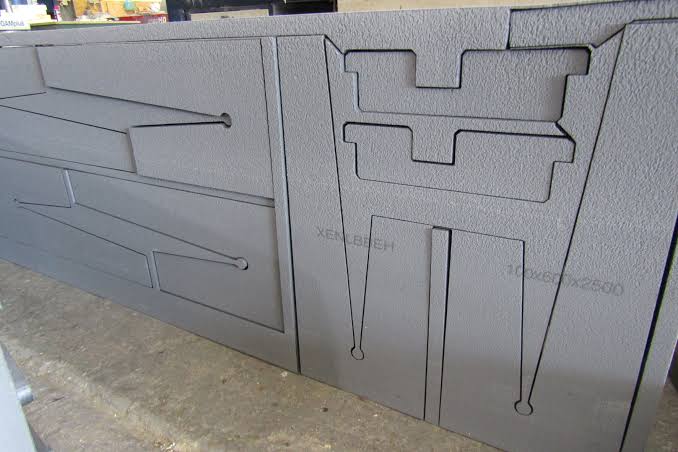
Hot wire cutting can be used to create bespoke EPS or XPS profiles and inserts for specialist or fragile products. Shaping the material to match the product can provide a more tailored fit than relying on a standard packaging size.
Events and exhibitions
Polystyrene is useful for creating lightweight sculptural and display forms.
Hot wire cutting can produce profiles for event, exhibition and promotional work where the design is based around a simple shape or repeated component.
For more intricate three-dimensional designs, CNC routing and milling may provide greater control.
Insulation components
Polystyrene is widely used in insulation applications, and hot wire cutting can produce components to a specified profile where the geometry is not highly complex.
Where the design incorporates more detailed features such as channels, rebates or cut-outs, CNC routing may be more appropriate.
When is hot wire cutting not the right fit?
Hot wire cutting is highly useful for suitable polystyrene profiles, but some designs call for a different machining approach. You may need to consider CNC routing and milling if your design involves:
- Complex 3D geometry
- Compound curves
- Detailed surface features
- Pockets or channels
- Rebates
- Access cut-outs
- More demanding dimensional requirements
- Materials other than EPS or XPS
CNC routing physically removes material using a cutting tool, giving it greater flexibility for detailed features and a wider range of materials.
If you are unsure which process your project requires, our guide to Hot Wire Cutting vs CNC Routing explains the differences and helps you compare the two approaches.
Hot wire cutting vs CNC routing: which should you choose?
The best place to start is with the shape and material you need to produce.
Hot wire cutting is generally suited to:
- EPS and XPS polystyrene
- Straightforward profiles
- Repeatable shapes
- Multiple consistent components
- Projects where speed and efficiency are important
- Applications where extensive surface detail is not required
CNC routing and milling is generally suited to:
- More complex 3D geometry
- Compound curves
- Detailed features
- Pockets, channels and rebates
- Detailed cut-outs
- Materials beyond EPS and XPS
Neither process is inherently better than the other. The right option comes down to your unique project requirements. Some projects may even benefit from combining processes, with hot wire cutting used to create the main profile before CNC routing adds more detailed features.
Why choose Perudo for hot wire cutting?
Choosing the right manufacturing process can be difficult when you are working from a drawing, specification or design rather than a knowledge of the machinery used to produce it.
Perudo Realisations combines hot wire cutting with CNC routing and other manufacturing processes, allowing the focus to remain on the finished component rather than simply the available machinery.
Our team can review your material, design and intended application and advise on the most appropriate approach. For some projects, that may be hot wire cutting. For others, CNC routing or a combination of processes may make more sense.
If you have a polystyrene component that needs to be produced to a specific profile, talk to the Perudo team about your project and discuss the most suitable manufacturing approach.
A few of
our clients







Read all our News & Insights
-

Hot Wire Cutting vs CNC Routing: Which Process Is Right for Your Project
Polystyrene converting and CNC routing and milling offer different manufacturing advantages, with Perudo helping you select the right process for your project.
-

Foam Glass Insulation: Cutting and Bespoke Sizing Explained
Foam glass insulation can be cut to size, tapered and profiled for roofing, flooring and industrial applications, with bespoke insulation processing from Perudo.
-

CNC Polystyrene Milling Explained: Precision Shapes for Complex Projects
Polystyrene converting and CNC routing and milling offer different manufacturing advantages, with Perudo helping you select the right process for your project.
-

What Is Hot Wire Foam Cutting and When Should You Use It?
Hot wire foam cutting creates precise, repeatable profiles in EPS and XPS polystyrene, offering an efficient solution for construction, packaging, display and insulation projects.